Crowns and Bridges
Crowns:
What is a crown?
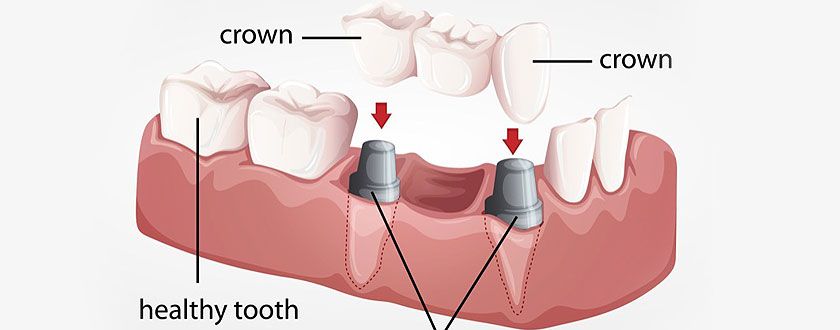
A crown is an artificial restoration that fits over the remaining part of a prepared tooth, making it strong and giving it the shape of a natural tooth. A crown is sometimes known as a 'cap'.
Why would I need a crown?
Crowns are an ideal restoration for teeth that have been broken, or have been weakened by decay or a very large filling. A crown could be used for a number of other reasons, for instance:
-
you may have discoloured fillings and would like to improve the appearance of the tooth
-
you may have had a root filling which will need a crown to protect what is left of the tooth.
-
it may help hold a bridge or denture firmly in place.
What is a crown made of?
Crowns can be made of a variety of different materials and new materials are continually being introduced. Some of the most popular options are listed below.
Porcelain/Ceramic bonded to precious metal: this is what most crowns are made from. A precious metal base is made and then porcelain is applied in layers over it.
Porcelain/Ceramic crowns: These crowns are made entirely out of porcelain and are not as strong as bonded crowns, but they can look very natural and are most often used for front teeth.
All-ceramic crowns: this modern technique offers a metal-free alternative, which can give the strength of a bonded crown and the appearance of a porcelain crown. Therefore it is suitable for use in all areas of the mouth.
Gold alloy crowns: gold is one of the oldest filling materials. Today it is used with other metal alloys to increase its strength, which makes it a very hardwearing restoration. These crowns are silver or gold in colour.
How is a crown prepared?
The dentist will prepare the tooth to the ideal shape for the crown. This will involve removing most of the outer surface, and leaving a strong inner core. The amount of the tooth removed will be the same as the thickness of the crown.
Once the tooth is shaped, the dentist will take an impression (mould) of the prepared tooth, one of the opposite jaw and possibly another to mark the way you bite together.
The impressions will then be given to the dental technician, along with an appropriate shade and other information needed for the crown to be made.
What is a post crown?
In root-filled teeth it may be necessary to insert a post before placing a crown. A post provides support and helps the crown stay in place. The weakened crown of the tooth may be shortened to gum level.
A post can be made of prefabricated stainless steel which the dentist can fit directly into the root canal, or a custom-made post can be constructed by the dental technician to accurately fit the shape of the prepared root canal. The post is placed into the root canal and cemented in position, ready for the crown to be attached.
Are there any alternatives to post crowns for root-filled teeth?
If a root-filled tooth is not completely broken down, it may be possible to build it up again using filling material. This 'core' is then prepared in the same way as a natural tooth and the impressions are taken.
What will happen between visits?
A temporary crown will be made so that you can use the tooth while you wait for the crown to be made. This crown may be more noticeable but is only a temporary measure.
How is the crown fitted?
When you and your dentist is happy with the fit and appearance of the new crown it will be fixed in place with special dental cement or adhesive. The cement forms a seal to hold the crown in place.
How long does the treatment take?
You will need to have at least two visits: the first for the preparation, impression, shade taking and fitting the temporary crown; and the second to fit the permanent crown. There will usually be about 1 to 2 weeks in between appointments. It varies depending on the crown selection.
Does it hurt to have a tooth prepared for a crown?
No, you will have a local anesthetic and the preparation should feel no different from a filling. If the tooth is root canal treated, and a post crown is being prepared, then you may not need a local anesthetic.
Will the crown be noticeable?
The crown will be made to match your other teeth as closely as possible. The shade of the neighbouring teeth will be recorded, to make sure that the colour looks natural and matches the surrounding teeth.
Will the crown feel different?
Because the shape of the crown will be slightly different from the shape of your tooth before it was crowned, you may be aware of it to begin with. Within a few days it should feel fine, and you will not notice it. The crown may need some adjustment if your bite does not feel comfortable, and if this is the case, you should ask your dentist to check and adjust it.
What will it cost?
Costs will vary according to the type of crown and material used. It is advisable to get a written estimate and treatment plan before beginning any dental treatment.
How do I care for my crown?
How long your crown lasts depends on how well you look after it. The crown itself cannot decay, but decay can start where the edge of the crown joins the tooth. Therefore, to prevent decay affecting the crown, it is important to keep this area just as clean as you would your natural teeth. Brush for two minutes twice a day with a fluoride toothpaste and clean in between your teeth with interdental brushes or floss.
How long will the crown last?
Properly cared for crowns should last for many years. Your dentist will be able to tell you how long the crown may be expected to last.
Bridge and Partial Dentures
Why should I replace missing teeth?
Your appearance is one reason. Another is that the gap left by a missing tooth can mean greater strain is put on the teeth at either side. A gap can also mean your "bite" is affected, because the teeth next to the space can lean into the gap and alter the way the upper and lower teeth bite together. This can then lead to food getting packed into the gap, which causes both decay and gum disease.
How are missing teeth replaced?
This depends on the number of teeth missing and on where they are in the mouth. The condition of the other teeth also affects the decision.
There are two main ways to replace the missing teeth.
The first is with a removable false tooth or teeth - a partial denture.
The second is with a fixed bridge. A bridge is usually used where there are fewer teeth to replace, or when the missing teeth are having tooth on both sides of the space.
What is a partial denture?
This is a plate with a number of false teeth on it. It may be all plastic or a mixture of metal and plastic. Both types may have clips (clasps), to help keep the denture in place in the mouth. Depending on where they are, some of these clips may show when you smile or open your mouth.
What is the difference between a plastic partial denture and one that contains metal?
Plastic partial dentures are less expensive to make. But unless they are designed very carefully they can damage the teeth they fit against.
Metal partial dentures are usually from an alloy of cobalt and chromium and they are much stronger. They are lighter to wear and can be supported by the remaining teeth. Although the base is metal, they have gum-coloured plastic and natural-looking teeth fixed to them. They are more expensive than the plastic ones.
How do I choose the best type for me?
Be guided by your dentist. He or she will know the condition of your remaining teeth.
Can I have a bridge fitted straight after having a tooth removed?
In many people it can take upto 6 months for the gums to heal properly after and extraction. This means that you may need to have a temporary denture for 6 months before the bridge is fitted.
How do I look after my denture?
The general rule is: brush, soak, brush. Always clean your dentures over a bowl of water or a folded towel in case you drop them. Brush your dentures before soaking, to help remove any food debris. The use of an effervescent denture cleaner will help remove stubborn stains and leave your denture feeling fresher - always follow the manufacturer's instructions - then brush the dentures again, as you would your own teeth, being careful not to scrub too hard as this may cause grooves in the surface.
Most dentists advice using a small to medium headed toothbrush and toothpaste. Make sure you clean all the surfaces of the dentures, including the surface which comes into contact with your gums. This is especially important if you use any kind of denture fixative.
If you notice a build up of stains or scale, have your denture cleaned by your dentist or hygienist.
Should I take my denture out at night?
Your dentist may recommend removing your dentures at night to give your mouth a chance to rest. If you remove your dentures, it is important to leave them in water to prevent any warping or cracking.
What is the alternative to a partial denture?
The main alternative is a fixed bridge. This is made by putting crowns on the teeth at either side of the space, and then joining these two crowns together by placing a false tooth in the space. This is all made in the laboratory and then the pieces are cemented into place with special adhesives. The bridge can't be removed.
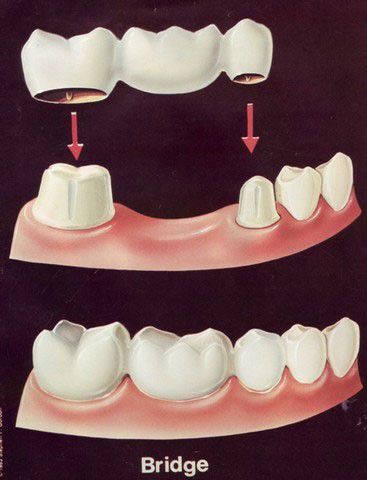
Another option is an adhesive bridge.
This has wings that are bonded to the back of the supporting teeth with very little drilling involved.
Can I always have a bridge to replace missing teeth?
Bridges are only possible if you have enough strong teeth with good bone support. Your dentist will help you decide which is the best way of replacing missing teeth.
What are bridges made of?
Bridges usually made of porcelain bonded to precious metal. Sometimes, there are other non-precious metals used in the base for strength. There are also new bridges made entirely of a special type of strong porcelain.
What will a bridge cost?
Cost will vary according to the size and type of bridge you need. Always get a written estimate and treatment plan before beginning any dental treatment. Although a bridge may seem expensive it should last many years.
How do I look after my bridge?
You need to clean your bridge every day, to prevent problems such as bad breath and gum disease. You also have to clean under the false tooth every day. Your dentist or hygienist will show you how to use a bridge needle or special floss, as a normal toothbrush cannot reach.
Are there other methods for fixing false teeth?
There are other methods, such as using a combination of crowns and partial dentures that can keep the retaining clips out of sight. These are quite specialized dentures, so you should ask your dentist about them.
Can I have teeth which attach to the jawbone?
Yes. By having implants. The success of this technique means you may be able to replace missing teeth without crowning other teeth. See our leaflet "Tell me about Implants" for more details. Remember that it is as important to care for your remaining teeth as it is to replace the missing ones